
Operations
Hotel and laundry: reconcile every linen handover
A shared method for comparing dispatches, receipts and returns, then resolving exceptions with clear ownership.

AI-created conceptual illustration for Linid; does not depict a customer site.
The hotel sees a dispatch. The laundry sees a receipt. If the teams use different boundaries and references, each can perform its own task correctly while neither can explain a discrepancy. Reconciliation creates a shared record of linen crossing between organisations and gives every difference a defined next step. It begins with agreement about the handover, not with a more impressive total on a dashboard.
Define the handover before comparing totals
Choose an identifiable unit of work: a route, delivery or batch handed over at an agreed point. Both partners need to recognise the handover reference. State the destination, linen families included and the moment when the list becomes validated.
Distinguish prepared linen from linen that actually departed. A piece may be removed after the first check. Without final validation or an explicit correction, the digital document describes an intention rather than the physical load. Make the person responsible for closing the batch known to the team.
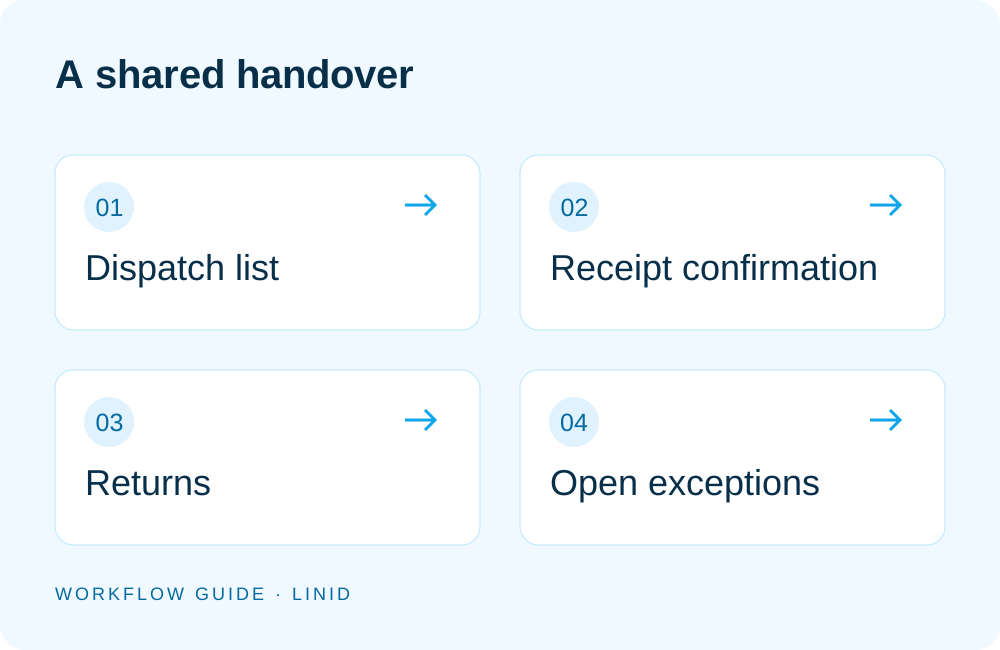 A shared reference connects the four stages; every difference retains a next action.
Confirm receipt within the same boundary
The laundry compares observed pieces with the hotel's dispatch list. It separates expected identifiers that are absent, unexpected pieces received and items that cannot be identified. A difference in the overall quantity cannot explain which situation occurred. Matching quantities do not prove that the identifiers match either.
Agree how to handle sealed bags, mixed batches and arrivals outside normal hours. If checking is deferred, that status should remain visible. Administrative receipt and physical verification may be separate events; both partners need to understand what each status means and what has not yet been checked.
Make partial returns explicit
Not every piece necessarily returns in one delivery. Normal turnaround depends on the agreement and operating conditions. Define together what counts as an expected return, an explained delay and an overdue item requiring investigation. Do not automatically classify every outstanding piece as lost.
Where the information is available, keep the connection between returned identifiers and their originating dispatches. Record retirement, repair and isolated items as well. These explain why a return cannot be reconciled like an ordinary delivery. Establish who tells the hotel about a piece removed from circulation and how that decision is documented.
Use one exception record
For each difference, retain the item or batch reference, last reliable observation, next action and owner. A status such as “check required” is useful only when it names an actual check and a review deadline. Teams should be able to distinguish an open investigation from a confirmed outcome.
- Unexpected piece: check its originating property and isolate it if necessary.
- Unread item: examine reading or association problems before drawing a conclusion.
- Incomplete return: check the agreed window and partial deliveries.
- Correction: retain the reason, date and approval of the change.
Do not remove the original record simply to make the totals match. An explainable correction supports the working relationship and distinguishes a recording incident from a repeated procedural problem.
Trial the method on one route
Choose a representative route with known contents. Deliberately prepare a partial-return scenario and an unexpected-item scenario. Check that both teams understand the other's document, actions have owners and closing an exception relies on retained evidence. These are trial scenarios, not customer results or a promise of a particular improvement.
Conclusion and reference
A reliable handover connects pieces, a location, a time and responsibility. RFID can support identification, but agreement about the stages remains essential. Explore solutions for hotels and laundries, then map your exchanges with Linid.
The GS1 EPCIS and CBV guidance provides context for distinguishing an observation from its business meaning. It is not a claim that your installation implements that standard.
← Back to the journal