
Operations
Linen discrepancies: measure before declaring a loss
Separate delays, recording errors and confirmed losses through a clear reconciliation method.

AI-created conceptual illustration for Linid; does not depict a customer site.
An item absent from an inventory is not automatically lost. It may be in an uncounted location, awaiting return or carrying an unreadable tag. Declaring a loss too quickly hides the real cause; waiting indefinitely prevents action. Use a qualification process with deadlines and clear ownership.
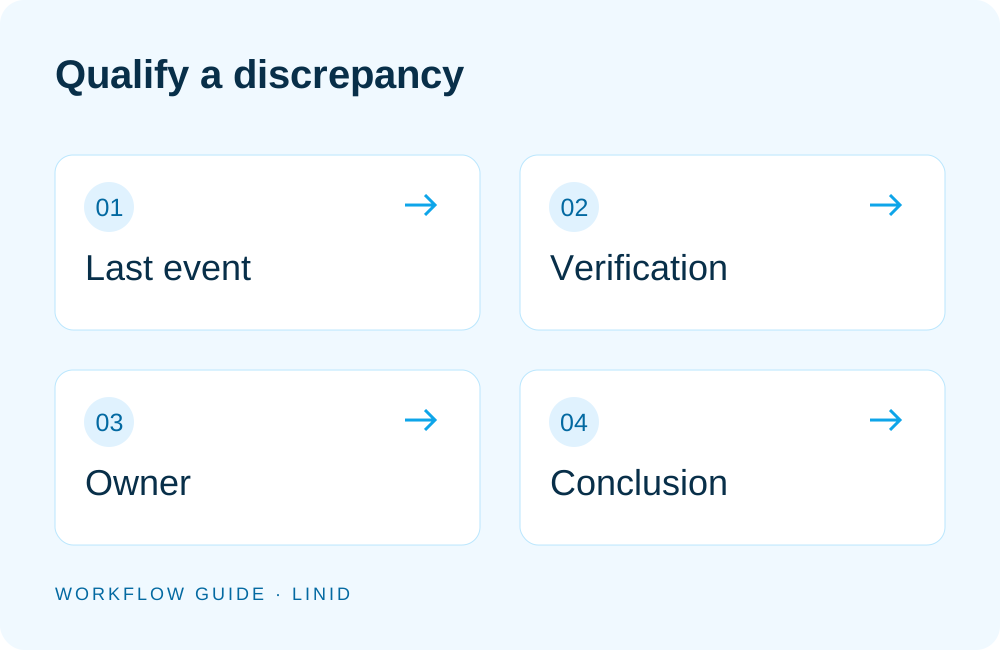 Workflow guide: Last event → Verification → Owner → Conclusion
Define the reconciliation boundary
Choose a period and the locations included. List opening stock, arrivals, departures and retirements. Check that events cover the same linen categories and that transfers between sites are not counted twice.
For a laundry exchange, compare dispatched identifiers with returned identifiers. Agree the normal return window and treatment of partial deliveries with your partner. Establish that rule before investigating discrepancies. Decide how weekends, exceptional closures and reprocessing affect the expected return date.
Classify exceptions
A single list of missing items often combines different problems. Use operational categories: return outstanding, item under inspection, movement requiring correction, tag requiring verification and confirmed loss. Every category should have a next action.
- Check neighbouring stock locations and waiting batches.
- Look up the last recorded event.
- Check retirements and changes of product reference.
- Document the conclusion and who approved it.
Avoid removing an incorrect operation without a trace. An explicit correction explains why the report changed and prevents the same case from being investigated repeatedly.
Read indicators in context
A raw missing-item count is not enough to compare two months. Throughput, tagged coverage and reading quality may have changed. State the denominator and distinguish open discrepancies from confirmed losses.
If estimating financial value, use an explicit reference cost approved by your organisation. Replacement price and accounting value answer different questions. Keep the result traceable to its assumptions. Do not present an estimate of exposure as a realised saving or a guaranteed recovery.
Investigate a cause, not a person
Group exceptions by checkpoint, textile category and process stage. Several missing items after the same station may indicate an incorrectly configured reading zone or an impractical procedure. Event history alone does not establish individual fault.
Observe the work with operators: carts moved after reading, mixed batches or damaged pieces removed from shipments. A simple workflow correction may be more useful than another alert. Retest the corrected process using both routine and unusual batches.
Turn an exception into a usable investigation record
Open a record containing the identifier, last reliable observation, expected return date and owner of the next action. Attach documents that actually concern the piece or batch. A dashboard screenshot alone does not replace an understandable chain of events.
Set a review deadline appropriate to the route. The case may close as a late return, movement correction, documented retirement or confirmed loss. Keep those conclusions separate in reporting. A recovered piece should leave the open-loss list while the correction remains available for review.
During the review, look for a repeated mechanism: dispatch validated before the cart is closed, temporary storage outside the inventory scope or a partial return treated as complete. Choose a procedural correction and check it on the next route. This learning loop is more useful than ranking individuals using incomplete observations. Keep the operational outcome separate from any financial estimate that has not been approved.
Establish a regular review
Assign open discrepancies, set a review date and close documented cases. Then check whether the corrective action reduced that same type of exception. The aim is a learning loop, not a more dramatic loss dashboard.
Both hotel operations and laundry operations benefit from this reconciliation discipline. Prepare anonymised examples when discussing your workflow with Linid.
Understanding RFID observations
GS1 RFID standards. A reading identifies an event; interpretation depends on the business process.
← Back to the journal