
Operations
Industrial laundry: build an inventory you can explain
Structure receipts, movements and returns to reconcile batches without losing sight of exceptions.

AI-created conceptual illustration for Linid; does not depict a customer site.
A piece count alone cannot explain a laundry’s inventory. Items may belong to different customers, await processing, sit in dispatch preparation or have already left. Useful inventory states what was counted and which events changed it. That discipline matters with or without RFID.
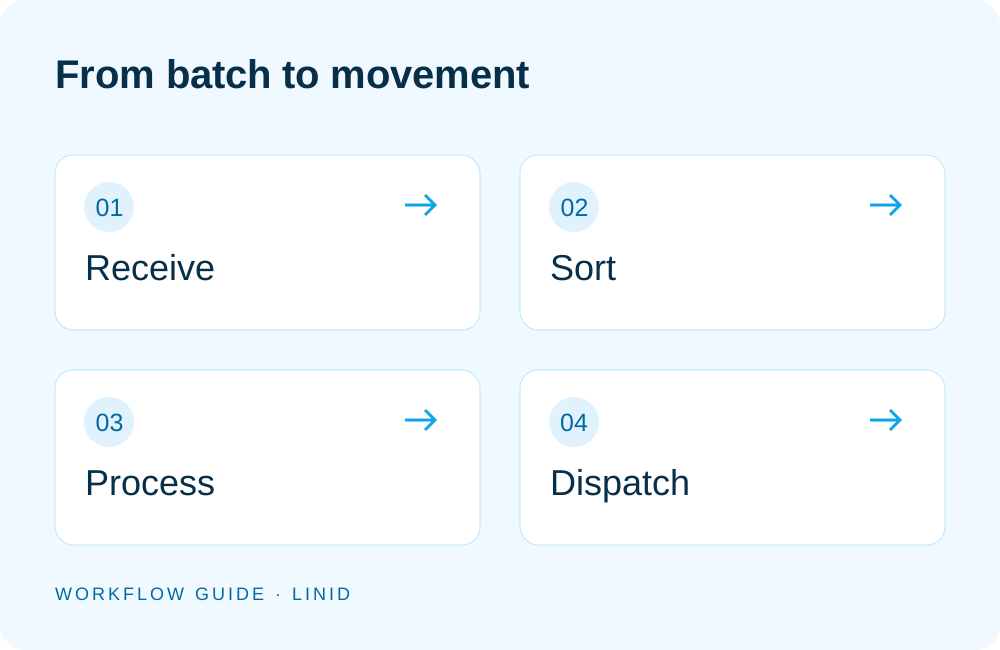 Workflow guide: Receive → Sort → Process → Dispatch
Define the units you track
Separate three concepts: the individual item, the product reference and the operational batch. A batch organises a receipt or dispatch; it should not erase the identity of its pieces. Also distinguish ownership from physical location.
Before configuring the system, name stock locations consistently. Two stations using the same word for different areas make reporting difficult to interpret. Provide a status for items needing inspection rather than forcing every piece into a normal category. Decide who can change ownership or move items between sites, and record why those changes happen.
Make receiving consistent
Receiving is a reconciliation point, not simply a counter. Identify the customer and delivery before reading the batch. Unknown items, identifiers already received and pieces assigned to another customer need investigation.
- Keep neighbouring carts outside the reading zone.
- Compare the reading with the expected physical contents.
- Separate exceptions physically.
- Validate the operation after checking, without erasing its history.
Separate movement from processing
An item passing an antenna does not prove it has been washed. To count cycles, define the event representing completed processing and the conditions that make it valid. Repeated readings at one station must not create multiple cycles.
Validate this rule with production supervisors. For rework or rewashing, distinguish a technical correction from a genuine new operation. Reports then become more useful for understanding textile life. A missing event should remain visible as a gap rather than be silently filled with an assumed wash.
Prepare a verifiable dispatch
Before departure, associate items with the destination and dispatch document. Check unexpected pieces and retain the identifiers actually sent. Your partner should be able to reconcile that list against its own receipt.
Define what happens if an item is read and then removed from the cart. Without a documented correction, it appears to have left while remaining on site. Last-minute checks are part of the workflow, not an incidental detail. Make the operator responsible for closing the shipment explicit.
Build a receiving control sheet
A useful control sheet connects the customer, transport document, physical batch and exceptions. It distinguishes expected pieces, identifiers actually read and items requiring inspection. Keep identification problems separate from disagreements about the declared quantity: they require different actions and different evidence.
During the pilot, prepare three situations: a compliant batch, a batch containing an unknown item and a batch with an incomplete document. Ask a trained operator to follow the procedure without help from the project lead. Record ambiguous steps, correction time and information that was unavailable when needed.
At the end of each shift, the supervisor reviews unvalidated receipts and assigns outstanding actions. Physically isolated pieces should remain findable in the record, with a location and a next review. Connecting floor organisation to the information system makes stock explainable. It also prevents a waiting area from becoming a permanent category in which unresolved discrepancies disappear. Repeat the exercise after changing a customer route or receiving station.
Measure process quality
Track receipts with exceptions, dispatches requiring correction and items awaiting reconciliation. Always show the scope and period. More discrepancies may reflect a changed method or better controls rather than deteriorating operations alone.
Begin with a representative customer and route, then extend validated rules. Explore Linid WashPro using your receiving and dispatch map. The first useful achievement is stock whose changes can each be explained.
Reference
GS1 RFID standards. Standardised identification does not replace the definition of business events.
← Back to the journal