
Technology
Textile RFID tags: validate durability in your wash process
Attachment, chemistry, temperature and reading: what to check before tagging your linen pool.

AI-created conceptual illustration for Linid; does not depict a customer site.
A washable label is not enough to select an RFID tag. Two laundries may use different temperatures, chemicals, pressures and finishing sequences. Selection should connect the tag’s technical specification with your actual process, then test the combination on representative textiles.
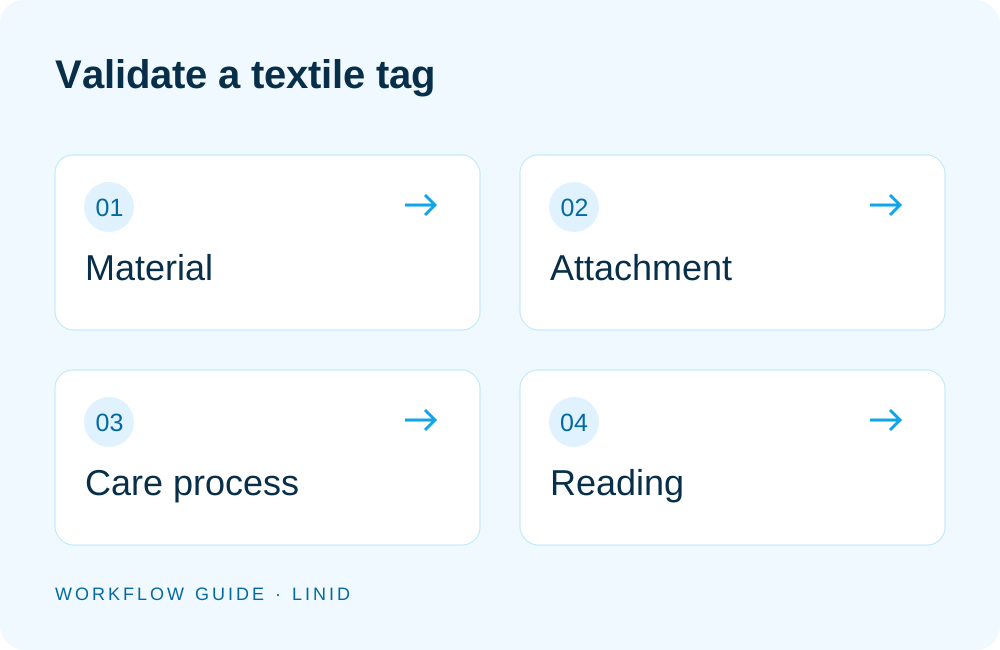 Workflow guide: Material → Attachment → Care process → Reading
Describe the process before the product
Collect temperatures, exposure times, chemistry and mechanical operations. Include drying, ironing and finishing: washing is only part of the journey. Record rework and exceptional treatments as well.
Ask the supplier for the exact conditions behind its stated limits. An isolated maximum does not necessarily describe repeated exposure. Do not apply one model’s cycle-life claim to every tag. Keep the specification version with your test records so later purchasing decisions refer to the same product requirements.
Choose attachment and position
A tag may be sewn in, integrated into a seam or attached through a manufacturer-approved process. The method must protect the textile, user comfort and tag integrity. Validate compatibility with both manufacturing and maintenance routines.
Position should be consistent enough to support inspection. A convenient manufacturing position may be less suitable for reading folded batches. Involve manufacturing and laundry teams together instead of treating their constraints independently. Check whether an attachment can be repaired without weakening the surrounding fabric.
Test reading under real conditions
Prepare dry, damp and packaged items as they will appear during operations. Use the usual carts and containers. Check expected identifiers, missed reads and neighbouring pieces detected in error.
- Check each tag before integration.
- Verify its association with the textile reference.
- Repeat measurements after multiple passes through the process.
- Keep a reference sample and the settings used in each trial.
Assess both readability and physical condition. A tag that still responds but damages the textile is not a satisfactory result. Include operator feedback about handling and comfort checks where the textile comes into contact with a guest.
Plan maintenance of the linen pool
Define how to identify a failed tag and replace its association without creating two active identities for the same piece. Retain the link to the previous identifier when history must remain usable.
When retiring a textile, close its status before reusing or destroying the tag according to your procedure. An identifier left active on an item removed from circulation can create difficult discrepancies. Make the replacement and retirement steps available to the staff who perform them.
Prepare an acceptance record with the supplier
Connect the exact tag reference to a linen family and attachment method. Add the supplier documentation version, tested conditions and rejection criteria: an opening seam, discomfort in use, textile damage or insufficient readability in the intended scenario.
Retain reference samples and identify the pieces submitted to testing. One successful observation does not establish the lifetime of the linen pool. Repeat checks at agreed stages and record actual conditions. If chemistry, finishing or the supplier changes, decide which checks must be repeated before another order.
The manufacturer and laundry should share the same references. A tag integrated during production must remain identifiable during replacement or investigation of a defect. The manufacturing traceability guide explains how to prepare that continuity without confusing a product reference with an individual item identifier. Acceptance should describe observed limits rather than repeat a general durability promise.
Document the decision
Approval should specify the model, attachment, textile families, tested process and observed limits. A supplier or treatment change may require another trial. Project quality depends on maintaining control over time, not merely achieving a good initial read.
Visit the technology page and prepare your process sheet for a discussion with Linid.
Reference
GS1 RFID explains the identification framework. Durability characteristics must come from documentation for the selected tag model.
← Back to the journal