
Implementation
Deploying RFID: a useful pilot before scaling up
Define objectives, responsibilities and acceptance criteria before extending linen tracking.

AI-created conceptual illustration for Linid; does not depict a customer site.
An RFID project does not start with installing a reader. It starts with an operational question and a way to verify that the answer improves. A well-defined pilot reduces ambiguity: it specifies the workflow, people involved, exceptions and decision expected at the end.
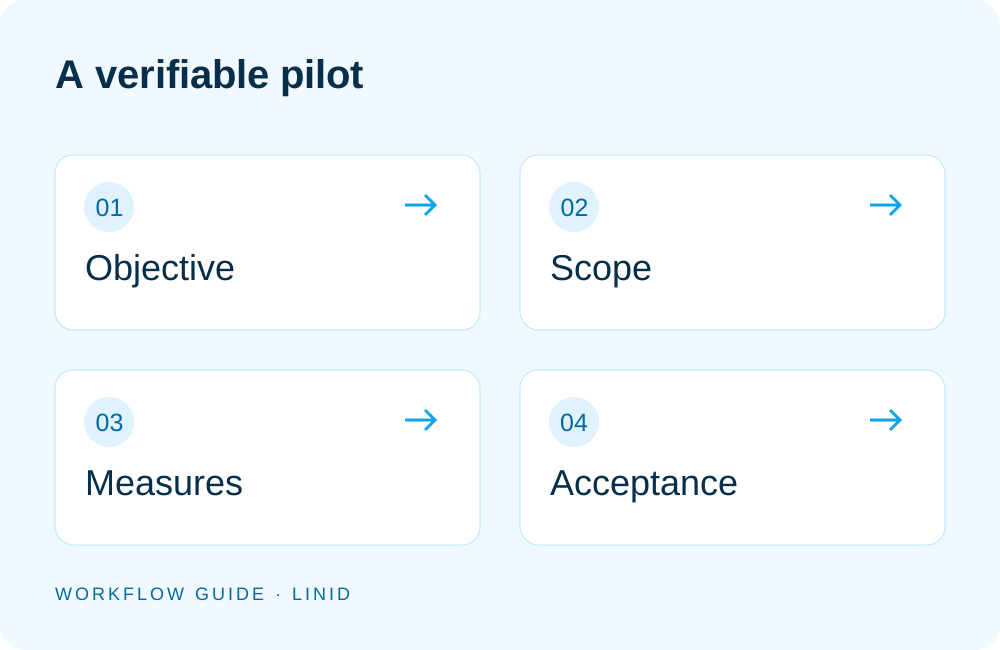 Workflow guide: Objective → Scope → Measures → Acceptance
Define an observable objective
Choose a question, such as reconciling linen dispatched to a laundry with items returned. Avoid vague objectives like automating everything. Define the required information and who will use the result.
Document the starting situation with the current method. Measure the complete task, including corrections and communication between teams. Without a baseline, a convincing demonstration does not establish a lasting improvement. Agree how changing volumes or staffing will be recorded during the comparison.
Map the route and its exceptions
Draw stock locations, transfers, washing stages and returns. Add unusual operations: rewashing, retirement, partial deliveries, site changes and network failure. Identify who validates each step.
- Which event creates a receipt?
- Who may correct a movement?
- How is an unknown item isolated?
- What happens when the reader is unavailable?
These answers influence equipment selection as much as linen volume. They also expose dependencies on partner procedures that may need agreement before the pilot begins.
Prepare a representative scope
Choose textiles and carts that resemble daily work, not only a batch that reads easily. Check tag durability and item associations. Define reading zones, user permissions and connectivity requirements.
Handheld and fixed readers serve different purposes. The Zebra RFD40 illustrates mobile UHF reading; the FX9600 is a fixed reader. These references are not an automatic equipment recommendation for your site.
Agree acceptance criteria before testing
Decide how expected reads, out-of-batch reads, corrections and total operation time will be measured. Specify test conditions and the repetitions your team considers representative.
Do not reduce the outcome to a manufacturer’s advertised reading speed. Useful performance includes moving carts, validating events and resolving anomalies. Review results with operators as well as the project team. Preserve unsuccessful trials: they often reveal the conditions a future rollout must avoid or address.
Prepare the operational launch
Write short procedures for normal operations and exceptions. Train lead users and plan an initial support period. Define when to fall back to a manual procedure if a critical step becomes unavailable.
Expand only after blocking issues have been resolved. Another site, textile family or workflow may require additional testing. Contact Linid with your workflow map to prepare a demonstration around your objective.
The handover pack before launch
Prepare a short operational pack the team can use without the implementation provider: reading-point map, validation rules, user permissions, correction method and outage instructions. Include known limitations and the situations that require a stop or a manual check.
Pilot acceptance should use documented trials, including unsuccessful scenarios. Check that an operations user can recover an interrupted movement, explain a duplicate and locate an isolated piece. Results need to be understood by the people who run the service each day, not only by the project sponsor.
Then define who approves a new zone, another textile family or a settings change. Each extension may alter reading conditions. Keep a versioned handover pack and a review date so that changes remain controlled after the initial demonstration. Assign ownership for keeping procedures, user training and the equipment configuration consistent.
Conclusion
The most useful pilot deliverable is a documented decision: what works, what needs correction and the conditions for expansion. That foundation prevents a successful demonstration from becoming an unverified promise about full-scale operations.
← Back to the journal