
Manufacturing
Manufacturers: build traceability into every linen item
Connect product references, individual identifiers and quality checks so customers receive usable item records.
AI-created conceptual illustration for Linid; does not depict a customer site.
Linen traceability does not have to begin with the hotel's first inventory. A manufacturer can prepare a usable identity during production by connecting the textile reference, tag and records supplied to the customer. The objective is not to collect every possible detail. It is to deliver a coherent set of information the recipient can understand, validate and maintain throughout the item's operational life.
Separate the product reference from the item identity
A product reference describes a family: dimensions, material, finish or another agreed characteristic. An individual identifier distinguishes one piece from every other piece. A batch number supplies another level of context for manufacturing investigations. These fields answer different questions and should not be treated as interchangeable.
Agree essential fields with the customer before production. A free-text name may be readable to an operator while being difficult to match against a catalogue. Use stable references, document their meaning and decide how changes to a range will be managed without rewriting the history of existing pieces. Confirm whether the customer's receiving process needs individual records or only a batch-level declaration.
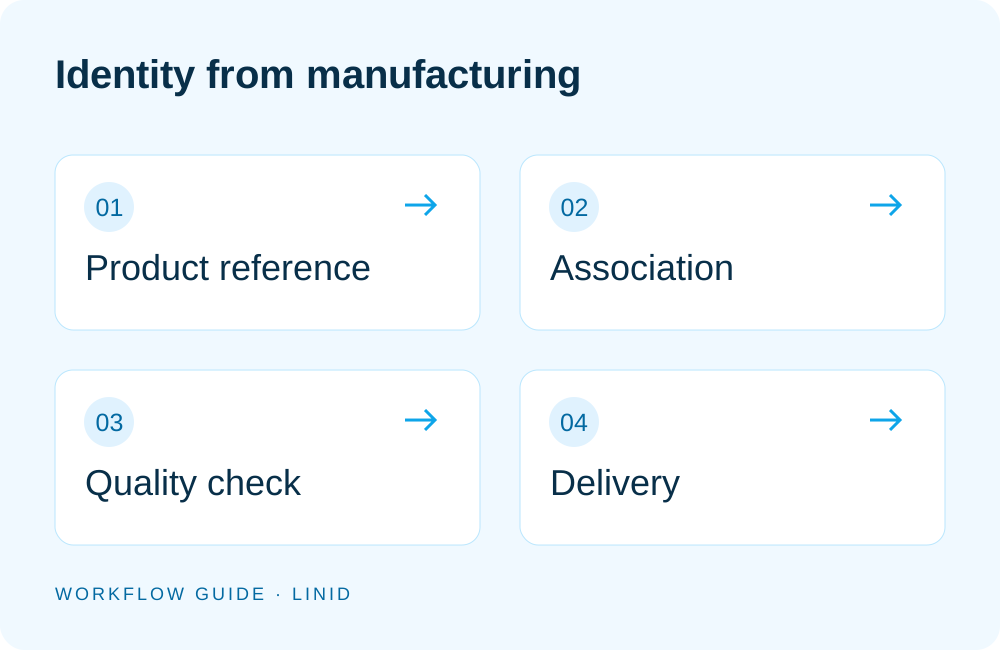 A usable identity connects the manufactured product, its identifier and the record supplied to the recipient.
Validate how the tag becomes part of the textile
Position and attachment must suit the textile, its use and its care process. The presence of a tag does not prove that the complete assembly will tolerate the customer's treatments. Confirm conditions with the supplier and plan representative trials before generalising the choice.
Retain the exact tag reference and integration method. Inspect the finished product as well: seam quality, comfort, the strength of the surrounding fabric and access for inspection. A component or attachment change should be identifiable so affected batches can be distinguished during a later check. Include the laundry's requirements instead of approving an attachment only for convenience on the production line.
Check the association before dispatch
Verification should establish that the identifier read corresponds to the correct textile reference. A readable identifier associated with the wrong article creates an error that can follow the piece through many operations. Define how duplicates, unreadable tags and pieces removed after checking are handled.
For a reference batch, compare physical contents against the file intended for the customer. Introduce an incorrect association deliberately in a test environment and observe how the team detects and corrects it. This evaluates the procedure; it does not describe a function guaranteed in every software product. Keep the test isolated from a real dispatch and preserve the approved result.
Deliver records the customer can use
Agree the exchange format, field names and validation rules. The recipient needs to understand which identifiers are arriving, the references they represent and the accompanying batch or document. A file containing ambiguous columns merely transfers the preparation work to receiving staff.
- Specify encoding and the expected reference formats.
- Check identifier uniqueness within the agreed boundary.
- Mark excluded or corrected records before the final transfer.
- Ask the recipient to confirm the file can be read and interpreted.
Avoid unnecessary personal data. The textile identity and delivery record are often sufficient for this step. Limit access and retain the version actually transferred so a later difference can be explained. Decide who can approve a corrected file and how the customer recognises the replacement version.
Plan for repair and replacement
A replacement tag should not leave two active identities for one piece. Define who approves the change and how the previous identifier remains connected to history where necessary. Replacing an entire textile is a different event and should remain distinguishable. A short procedure helps prevent staff from solving a reading problem by creating a new unexplained item.
Conclusion and reference
Traceability quality depends on the first association and the exchange of records as much as radio reading. Prepare a small verified batch with the customer before scaling. Explore Linid Loom and the guide to textile RFID tags.
GS1 RFID standards provide an identification framework. Identifier selection, encoding and supported treatments must be confirmed for the particular project.
← Back to the journal